
What Fannin County Property Tax Records Contain
Two offices divide the work. In Fannin County, the Board of Tax Assessors keeps the parcel-centered view through its QPublic card. That card names the owner on the certified tax roll, lists mailing and situs addresses, details land and buildings, and tracks value history, exemptions, and sales. A sketch appears when one exists. The Tax Commissioner then applies the approved digest and millage, mails the tax bill, takes payment, and pursues delinquency. Read both records together. Neither office alone gives the full history of a parcel.
| Field | What It Shows | Where |
|---|---|---|
| Fair-market value | The assessor's estimate of full value for the tax roll | QPublic assessor card |
| Assessed value | Forty percent of fair-market value before applicable exemptions | Board of Tax Assessors |
| Exemptions | Approved reductions that affect taxable value | Assessor record and application file |
| Bill and payment | Current charge, due status, and collection history exposed by the portal | Tax Commissioner |
| Delinquency or Fi. Fa. | Unpaid-tax enforcement that may become a recorded lien | Tax Commissioner and Clerk |
Georgia law generally puts taxable value at 40 percent of fair-market value under O.C.G.A. §48-5-7. That explains the gap. An assessed figure sits well below the fair-market figure. It will not predict a sale price. Exemptions can shrink the taxable base further, and millage turns that base into the actual tax bill. A deed price is different evidence entirely and may match no number on the tax roll.
Read Fannin County's QPublic Value History
Start with the county-linked QPublic assessor portal for any assessment question. Search by address, owner, or parcel identifier. Then confirm the situs address and legal-description clues before trusting the match. A Fannin card may break out land, improvement, and accessory values, plus current and prior-year figures, sales, and building details. Those fields show what changed on the parcel. They also reveal whether land or structures drove the change.
| Portal field | Use it to check | Important limit |
|---|---|---|
| Owner and mailing address | The taxpayer name and destination for notices | May lag a deed recorded after the roll date |
| Parcel and location address | The exact tax account and physical site | Rural address text can vary |
| Value history | Year-to-year land and improvement changes | Reflects the displayed roll and upload |
| Sales history | A lead to a transfer | Not proof of consideration or title |
Record the tax year and the portal's last-data-upload note with any printout. The public report states that assessment data reflects the last certified tax roll while other details can shift. That timestamp shapes the record's meaning.
The January 1 Owner Rule in Fannin County
January 1 controls the tax bill in Fannin County. The bill normally goes to the owner of record on that date. So a house sold in June may show the new grantee in the deed index while the tax bill still names the earlier owner. Timing explains the mismatch. It is not necessarily an error. When names differ, compare the QPublic roll year against the newest recorded deed and hold the parcel ID constant throughout.
Timing clue. A later closing does not automatically rewrite the owner name on a bill already tied to the January 1 tax cycle.
The mailing address is not the situs address either. One tells you where mail goes. The other identifies the land itself. An owner may list an out-of-county mailing address, and a lender or agent may receive certain notices, so match on the parcel rather than a shared street name.
Look Up a Fannin County Tax Bill
The official Tax Commissioner site links the county's tax lookup and payment service. Its online search may present a CAPTCHA, so plan on a human browser session. An address search may come up empty. Return to QPublic and copy the exact parcel identifier. Run that number in the bill system. Keep the assessment and collection pages in separate tabs. The year, account, and owner then line up side by side.
- Find the parcel in QPublic and verify its physical address.
- Open the Tax Commissioner lookup and search the same parcel or owner.
- Read the bill year, charge, and displayed payment or delinquency status.
- Return to the assessor card to confirm the value and exemptions behind that tax year.
- Contact the Tax Commissioner if a payment, payoff, or older year is not clear online.
- Assessed value
- The statutory share of fair-market value used as the starting tax base.
- Millage or levy
- The adopted rate applied to taxable value to calculate a charge.
- Homestead exemption
- Relief for a qualifying owner-occupied home after approval.
- Tax lien
- A public claim arising from unpaid taxes, often reflected through a Fi. Fa.
Fannin County's May-to-December Tax Calendar
The local calendar drives what a property search returns at any given moment. Assessment notices generally go out in May. The notice then opens a 45-day appeal window for the taxpayer. Bills normally mail in mid-September. Real estate and business personal-property taxes are normally due December 20. Each event creates its own document. The latest bill does not replace the assessment notice. An appeal file proves no payment. The Tax Commissioner's tax explanation displays the county calendar. It also lays out assessment rules as a visual reference.
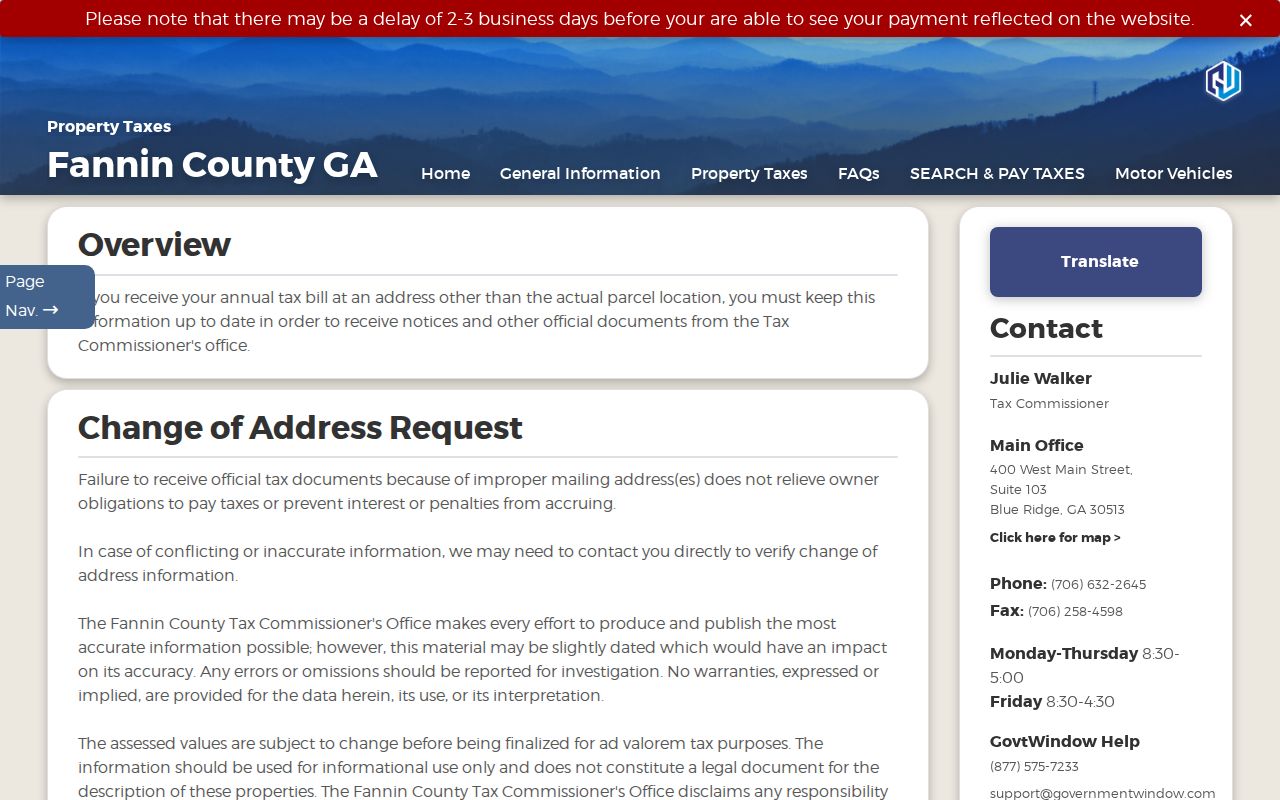
Confirm the active year's schedule from the live page and the date on the current notice or bill.
| Point in cycle | Record to retain | Office |
|---|---|---|
| January 1 | Owner and property status for the cycle | Tax Assessors |
| May notice period | Annual assessment notice | Tax Assessors |
| Mid-September | Issued tax bill | Tax Commissioner |
| December 20 | Payment receipt or delinquent status | Tax Commissioner |
These are the county's normal timing statements. When a printed notice or bill shows a different deadline, follow the document's own date.
Homestead and Special Exemptions in Fannin County
An exemption changes taxable value, not the fair-market estimate beneath it. The assessor decides whether an application qualifies and records the approved exemption on the parcel. A homestead claim hinges on owner occupancy. Other relief can add age, disability, veteran, or income rules. Eligibility and proof shift over time. So rely on the Tax Assessor's current forms rather than copying a prior owner's exemption from the parcel card. Look closely at Fannin County property tax records. Line the exemption field up with the assessment year. A sale or a change in occupancy can alter later treatment. The record shows what the office applied for that cycle. It is not a promise of future eligibility. Direct application questions to the assessor at 706-632-5954.
Appeal a Fannin County Assessment on Time
An appeal begins with the assessment notice. The tax bill arrives too late to dispute. Fannin County allows 45 days from the notice date to contest the valuation. Check the parcel first. Compare the land acreage, structures, accessory items, value history, and sales entries against what you know about the property. Strong evidence names the parcel and states the claimed error, whether that is a wrong building feature, an acreage mismatch, or market data tied to the valuation date, and keep proof of delivery plus copies of every attachment.
Appeal window. File with the Fannin County Board of Tax Assessors within the 45-day period printed on the assessment notice.
The appeal targets the assessment itself. Payment questions go to the Tax Commissioner. For help reading the figures, the Fannin County property value guide explains what each number means.
Delinquent Fannin County Property Tax and Fi. Fa.
Unpaid tax in Fannin County can turn into a Fi. Fa., a tax execution the Tax Commissioner issues. That execution is a public lien. It can surface among Clerk records. A careful search separates an unpaid bill from a recorded execution, a later satisfaction, and a tax-sale notice, because those are distinct stages. One old delinquency entry does not equal a sale. For a payoff or status you must rely on, get a current answer from the Tax Commissioner. Then search Clerk filings by owner name. Fannin's Clerk records deeds, liens, notices of suit, and releases that can change the picture. A portal screen is no title report.
Request Fannin County Tax Records Beyond the Portal
Not every record appears in a public search. Assessment worksheets, correspondence, older bills, payment details, and land-development files may all sit outside the portal. Send the request to the creating office. List the parcel ID, owner, and address. Add the tax year and the record wanted. Georgia's Open Records Act generally requires a response within three business days or an explanation of availability, cost, or an exemption, and the county form distinguishes inspection or copying from a request to receive copies. Fees can apply. After the first 15 minutes, search, retrieval, and redaction time is billed at the rate of the lowest-paid qualified employee. The county form generally sets $0.10 per ordinary page. Statutory or certified-copy fees control instead when they apply, and narrow dates plus exact parcel keys help the custodian pull the right file without wasted effort.