
Trace a Fannin Address to Its Owner
An address needs two records to yield an owner. QPublic finds the tax parcel and its Owner field. The GSCCCA index then locates the newest deed. Matching them separates a quick public answer from recorded proof. It also catches a recent sale that has not yet reached the certified tax roll.
- Search the physical address in Fannin QPublic. Save the exact parcel ID, Owner, situs, mailing address, and legal description.
- Search that owner as grantee in the GSCCCA real-estate index. Match the parcel description and find the newest recording date.
- If a trust, estate, or company appears, read the deed for the signing capacity and related names. Use the state business search for a Georgia entity.
- Compare dates. Treat the latest recorded conveyance as newer evidence when it postdates the assessor snapshot.
Begin With Fannin's Owner Field
Fannin's indexed parcel reports label the field simply Owner. It sits beside Mailing Address, Physical Address, parcel ID, account key, class, taxing district, acres, value, sales, map, and sketch fields. Owner means the name on the assessment roll. It does not certify title. Nor does it list every person who uses the site. Record the card's last-data-upload date as well. QPublic states that assessment data comes from the last certified tax roll while other facts can change, so that timestamp matters whenever an owner name differs from a deed recorded later. Start with the official Fannin QPublic entry, then check the parcel card it returns.
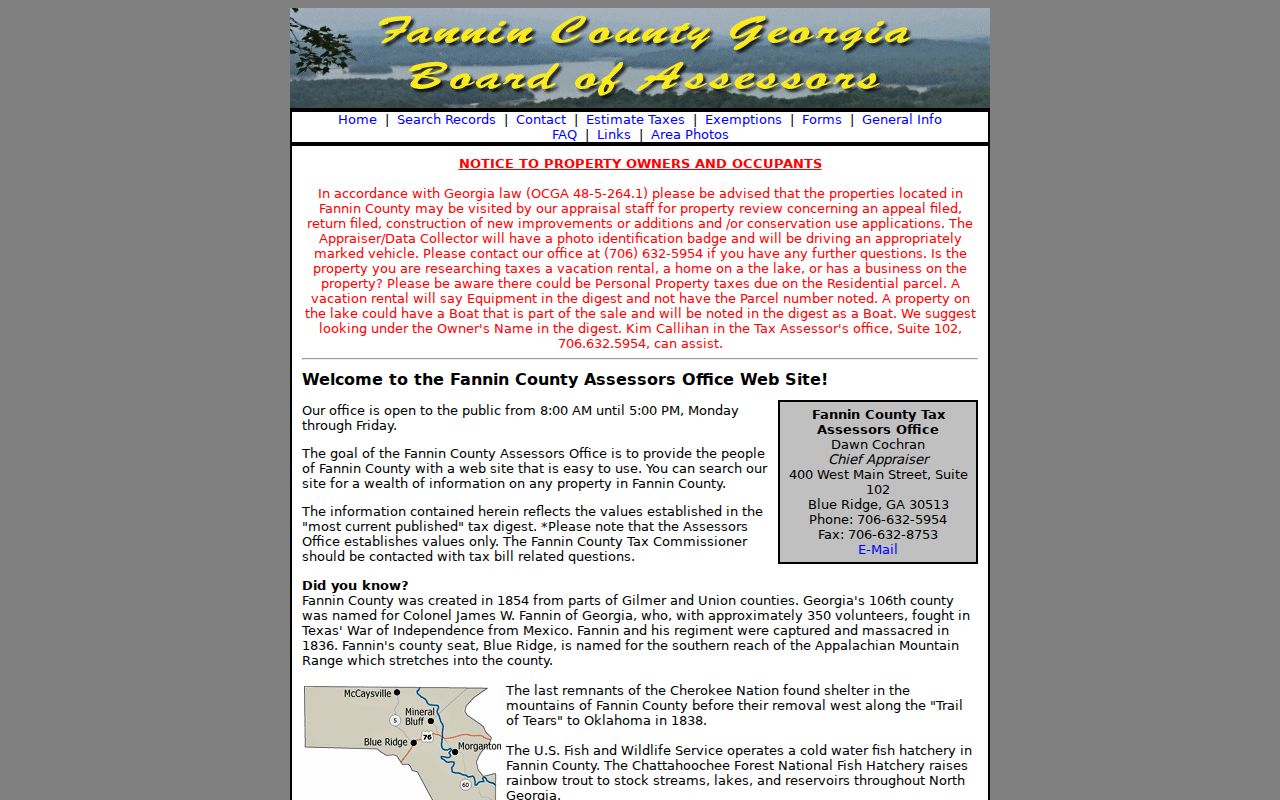
The image identifies the county-published QPublic starting point. The parcel result, not the entry page alone, supplies the owner and parcel fields a search actually needs.
Fannin Owner Mail Is Different
The situs address points to the assessed tract. The mailing address is where notices and tax bills travel, and it may sit outside the county or even the state. Confusing the two can make a search look wrong. Mountain roads and broad postal-city names add further uncertainty. Anchor on the situs for location and the parcel ID for the match. Treat the mailing field only as a contact clue. When a road variant or unnumbered tract appears, compare the map, nearby parcels, and legal description. Do not assume no property record exists.
Sources That Identify Fannin Owners
Every source names an owner for its own purpose. No single list settles it. The strongest answer to who owns this property comes from matching the tax parcel to the newest recorded deed, not from one name standing alone.
| Source | Owner Info It Gives | Access |
|---|---|---|
| QPublic assessment roll | Owner, mailing and situs fields | County-linked online search; assessor office |
| GSCCCA deed index | Newest grantee and conveyance date | Online index; Clerk counter and books |
| Georgia eCorp | Entity, control number, agent, officers | Free state business search |
| Parcel map | Parcel key and location context | QPublic map and ArcGIS parcel service |
No source here shows who actually occupies the land.
Confirm Fannin's Newest Grantee
In a deed, the grantor gives up an interest and the grantee takes it. Search the QPublic owner as grantee. Pick Fannin County and compare recording dates. Then match the deed's legal description against the parcel card. Check the subdivision, land lot, district, section, or book-page references too. The GSCCCA name form lists coverage from 1990 to current. The system description cites 1999 forward plus 1993-1998 additions. Check the live good-from date before trusting a negative result. If the online index stops, the Clerk's counter, deed books, and microfilm remain open routes. Certified copies come from the custodian or eCertification where offered.
- Owner of record
- The owner name shown by a stated public source at a stated time.
- Grantee
- The party receiving the deeded interest.
- Vesting
- The form in which ownership is held.
- Situs
- The property's physical location, not the mailing destination.
When Fannin's Roll and Deed Differ
Fannin tax records carry a January 1 owner date. Assessment notices usually follow in May. Tax bills reach that owner even after a sale. A buyer can hold a recorded deed while the prior owner still appears on that year's bill or roll snapshot. No official source promises a fixed update lag. Compare the deed's recording date with QPublic's upload and certified-roll notices. A later deed is newer conveyance evidence, but not always the end of a title question. Corrective deeds, life estates, survivorship terms, estate administration, liens, and court orders can all change the result.
Trusts and Companies in Fannin Records
A trust, limited liability company, corporation, or estate can appear as both the QPublic Owner and the deed grantee. Search the entity name exactly first. Then try punctuation-free versions and likely abbreviations. Read the deed for trustees, managers, executors, or signers, and note the capacity in which each acted. Georgia gives entities their own lookup. The Georgia eCorp Business Search accepts business name, control number, registered agent, and officer name, with Starts With, Contains, and Exact Match options. It can explain a Georgia entity record. It does not prove the registered agent owns the land.
Fannin Estates Change Owner Trails
Death rarely produces a simple sale deed in Fannin County. Probate Court files may hold wills, petitions, inventories, and returns. They may also hold letters of administration, executor authority, and orders explaining how property passed. A deed under power or an executor's deed may then surface in the Clerk's real-estate records. Fannin offers no public online probate case search. Ask the Probate Court counter at 706-632-3011 for the estate file. Then compare names and legal descriptions with the deed index. Georgia death certificates carry eligibility limits. So a public inquiry should lean on the open probate and deed materials for the tract. Those records usually tell the story.
Fannin Liens Do Not Equal Ownership
A lien is not a title. Security deeds, tax fifas, lis pendens, and notices of suit can all name a lender, plaintiff, or judgment creditor. None of that makes them the owner of record in Fannin County. The Clerk records each instrument. These range from deeds and easements to liens, notices, trusts, and powers of attorney. Search the newest conveyance first. Then read later instruments for claims or releases.
Fannin Superior Court hears title and equity disputes. Its filings can explain a quiet-title, partition, or foreclosure fight over county land. A docket entry is not the final result; the disposition or order controls. Federal litigation involving Fannin property may be searched through PACER. That covers the Northern District of Georgia.
Fannin Owner Filing Alerts
Georgia's FANS service is free. It notifies a subscriber when a name or address matches a new real-estate, lien, UCC, or plat filing. That makes it a useful way to watch for activity after an owner of record has been identified in the deed records. The Georgia Attorney General also points owners to FANS in current title-theft guidance.
Register through the official FANS portal. Add sensible name variants when you subscribe. An alert is only a prompt. It does not prevent a filing, confirm identity, or answer who owns this property.
Limits of a Fannin Owner Search
Public property records answer some questions, not all. They identify owners of record, legal transfers, tax accounts, and mapped parcels. They do not prove who lives at an address. Nor do they guarantee clear title, settle a boundary dispute, or explain every private interest in the parcel. Commercial data can be stale or merge same-name people. Let the official deed and tax records settle any conclusion about a Fannin County property.
Georgia's VoteSafe program protects the residence address of qualified voters under a protective or restraining order or in a family-violence shelter. That protection does not erase a lawfully public deed or tax record. Ask the right custodian about any statutory restriction. No owner can simply remove a valid land record.
Lawful use. Use a Fannin County owner lookup for property research, purchase diligence, estate work, and civic transparency. Never use owner data to stalk, harass, threaten, or harm anyone.